
Imagine returning home after a long day in the Qatar heat, expecting a sanctuary of cool air, only to find your living space feels like an oven. You check the vents, but the air is lukewarm, and the temperature on the wall continues to climb. This frustrating moment leads to one urgent question: why is my AC not cooling? In a region where system reliability is the top priority for 38% of consumers according to industry data, a sudden loss of cooling is more than a simple inconvenience; it’s a direct threat to your household comfort.
It’s completely normal to feel overwhelmed when your climate control fails. You might worry about navigating technical jargon or fear that a significant repair cost is unavoidable. We believe every homeowner deserves a clear, honest understanding of their property’s vital systems. This guide identifies the most likely reasons your air conditioning has stopped working and explains which issues you can resolve yourself versus when you need a professional partner.
We’ll examine common maintenance gaps like dirty filters and incorrect thermostat settings. We’ll also look at more complex mechanical faults, such as capacitor failures or refrigerant leaks. By the end of this article, you’ll have a methodical plan to restore your cool home environment and the confidence to handle any necessary repairs efficiently.
Key Takeaways
- Learn how to verify your thermostat and circuit breaker settings to rule out simple power issues before seeking technical help.
- Understand how dust accumulation and clogged filters answer the question of why is my AC not cooling by restricting airflow and straining the compressor.
- Recognize the critical signs of a refrigerant leak, such as unusual hissing sounds or ice formation, which require immediate professional attention.
- Discover why the extreme ambient temperatures in Qatar often push air conditioning units beyond their “Delta T” cooling capacity.
- Determine the exact moment to transition from DIY troubleshooting to a methodical professional inspection to protect your system’s longevity.
Immediate Troubleshooting: Immediate Checks for an AC That Isn’t Cooling
When you find yourself asking why is my AC not cooling, it’s best to start with a methodical inspection of the most accessible components. Many issues that appear to be major mechanical failures are actually minor logistical oversights that can be resolved in minutes. By following a structured checklist, you can potentially restore comfort to your home without the need for a service call. Begin your investigation with these four essential steps:
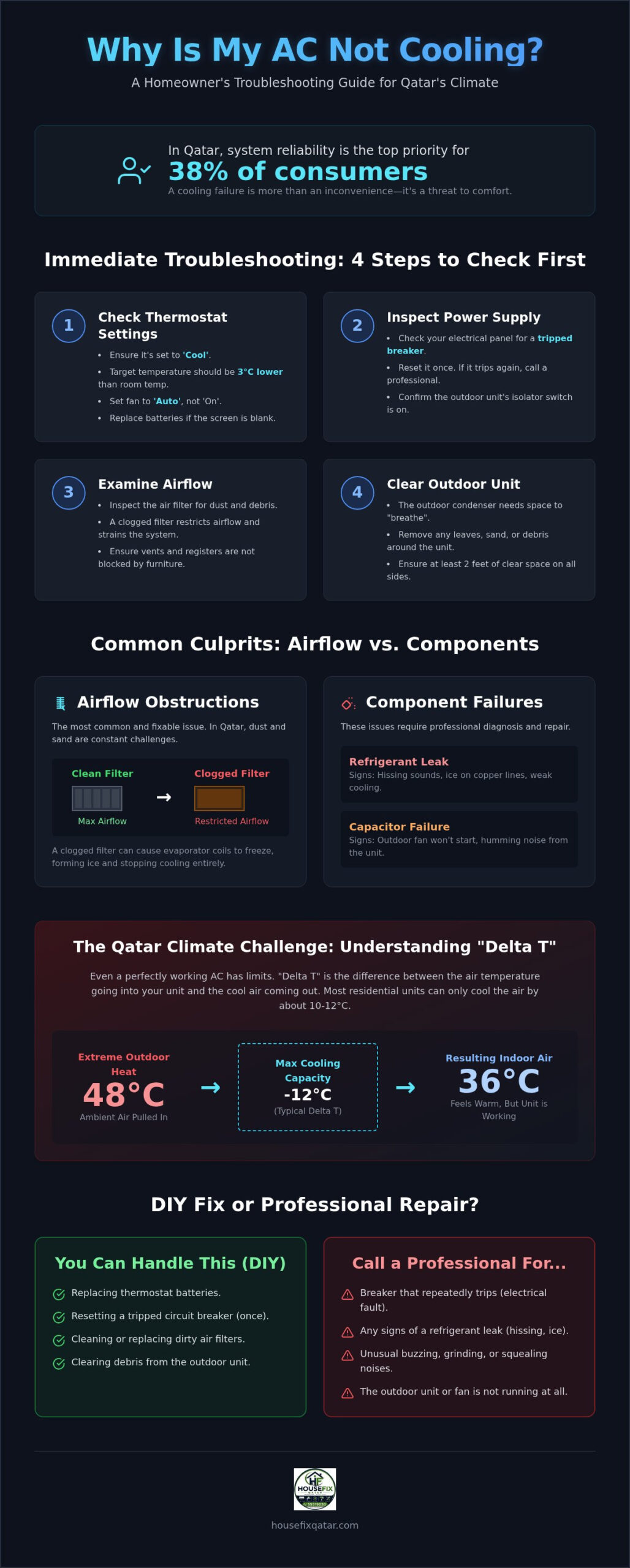
- Verify the thermostat is set to ‘Cool’ and the target temperature is at least three degrees lower than the current room temperature.
- Check your home’s electrical panel for any tripped circuit breakers dedicated to the HVAC system.
- Confirm that both the indoor air handler and the outdoor condenser unit are receiving power and show signs of operation.
- Look for specific ‘Error Codes’ displayed on the digital interface of your unit, which often point directly to the underlying fault.
Thermostat Settings and Battery Power
A blank thermostat screen is a common reason for a system failure. If the display is dark, it likely needs new batteries to restore communication with the rest of the system. Even with power, you must ensure the fan setting is on ‘Auto’ rather than ‘On’. When the fan is set to ‘On’, it blows air continuously even when the cooling cycle is inactive, which often results in lukewarm air circulating through your rooms. Understanding How Air Conditioning Works clarifies that the fan and the cooling mechanism are separate functions that must coordinate correctly. After you adjust any settings, wait at least five minutes for the compressor to engage, as most modern units have built-in safety delays to prevent damage from short-cycling.
Inspecting the Circuit Breaker and Power Supply
The extreme ambient temperatures in Qatar put significant stress on electrical components. During peak summer months, your AC unit works harder and draws more current, which can cause the dedicated HVAC breaker to trip as a safety precaution. Locate your electrical panel and look for switches that have moved to the middle or ‘Off’ position. You can attempt to reset the breaker once, but if it trips again immediately, it indicates a deeper electrical issue that requires a professional assessment. Additionally, check the outdoor isolator switch. This switch is located near the condenser unit and can sometimes be accidentally turned off during routine cleaning or property maintenance. Ensuring a stable power supply is a critical step in diagnosing why is my AC not cooling before moving on to more complex internal components.
Airflow Obstructions and the Impact of Dust
Airflow is the fundamental mechanism that allows your HVAC system to regulate indoor temperatures. In the specific climate of Qatar, airborne dust and fine sand particles are constant challenges that can quickly compromise this process. If you find yourself asking why is my AC not cooling, the answer often lies in a physical obstruction that prevents the system from “breathing” correctly. When air cannot move freely over the internal evaporator coils, the system must work significantly harder to achieve the same cooling effect, which places undue stress on the compressor and increases energy consumption.
Beyond the internal filters, blocked return vents frequently cause uneven cooling across a property. Homeowners sometimes inadvertently place furniture, curtains, or decorative items in front of these vents, which disrupts the balanced air pressure the system requires. This imbalance forces some rooms to remain warm while others might feel slightly cooler, creating an inconsistent and uncomfortable environment. Visual signs of a problem include visible dust buildup around the vent slats or a noticeable whistling sound as the system struggles to pull in enough air.
The Vital Role of Clean Air Filters
Most residential systems in the region utilize either disposable pleated filters or washable plastic mesh variants. You can usually locate these by opening the front panel of a split unit or checking the dedicated filter slot in a ducted system. A simple visual inspection often reveals a thick layer of grey dust that acts as an insulating blanket. A heavily clogged filter creates a cycle where restricted airflow causes the evaporator coils to drop below freezing, eventually leading to a layer of ice that completely blocks any remaining cooling capacity. Regularly checking these filters is the most effective way to prevent this specific failure.
Outdoor Unit Maintenance in Dusty Environments
The outdoor condenser unit is responsible for releasing the heat absorbed from your indoor spaces into the outside air. Because these units are exposed to the elements, the delicate metal fins can become packed with sand and debris during local windstorms. A “suffocated” outdoor unit cannot dissipate heat effectively, which causes the entire cooling cycle to stall. It’s essential to clear any storage items, plants, or debris from the area immediately surrounding the fan to ensure a minimum of two feet of clearance for optimal heat exchange. If you’ve cleared these obstructions and still face issues, a professional AC repair service can perform a deep chemical clean of the coils to restore full efficiency. Maintaining these external components is a critical step in diagnosing why is my AC not cooling during the peak summer months.
Internal Component Failures and Refrigerant Issues
Internal mechanical failures often represent the most complex reasons for system inefficiency. If your initial checks of the thermostat and filters didn’t resolve the issue, the problem might be hidden within the chemical or electrical heart of the unit. Understanding the relationship between the refrigerant and the electrical starters is essential to identifying why is my AC not cooling correctly. These systems rely on a delicate balance of pressure and power to maintain a comfortable indoor climate.
Refrigerant serves as the heat-transfer medium in a closed-loop system. It’s a common misconception that this gas is consumed like fuel; in reality, it should circulate indefinitely. A drop in cooling capacity often stems from a physical breach in the copper lines. Symptoms of a leak include a distinct hissing sound near the unit or the presence of ice on the evaporator coils. Additionally, electrical components like the capacitor or contactor act as the “on” switch for the compressor. If these parts fail due to wear or electrical surges, the compressor won’t start, leaving you with nothing but lukewarm air circulating through your vents.
Diagnosing Refrigerant Leaks and Low Levels
Identifying a leak requires a methodical eye. You might notice an oily residue around the refrigerant line connections, which occurs because the lubricating oil used in the compressor escapes along with the gas. You must recognize that simply “topping up” the gas is a temporary measure that fails to address the underlying fault. The leak must be professionally sealed to ensure long-term reliability. Technicians use specialized gauges to measure gas pressure accurately, as even a small deviation from the manufacturer’s specifications can drastically reduce cooling performance in the Qatar heat.
Frozen Evaporator Coils and Component Wear
The evaporator coil is responsible for extracting heat from your indoor air. If you see water dripping from the unit, it’s often a sign of melting ice caused by a frozen coil. This happens when dirt accumulates on the metal fins, acting as an insulator that prevents the refrigerant from absorbing heat. This lack of heat transfer causes the coil’s temperature to plummet, leading to ice formation that eventually blocks all airflow. Beyond the coils, a failing compressor motor or fan motor can cause the system to shut down entirely. These components endure heavy loads during the summer months and require periodic inspection to ensure they continue to operate within safe parameters, helping you avoid the frustration of why is my AC not cooling when you need it most.
Why AC Units Struggle in Extreme Heat Environments
In Qatar, the outdoor environment presents a unique set of challenges that can push even the most robust HVAC systems to their physical limits. When homeowners ask why is my AC not cooling during the peak of summer, the answer often involves the laws of thermodynamics rather than a specific mechanical fault. Most residential air conditioning units are designed to achieve a “Delta T” of approximately 8 to 12 degrees Celsius. This value represents the maximum temperature difference the system can maintain between the outdoor ambient air and the indoor environment. When external temperatures exceed 45°C or even approach 50°C, a unit that is functioning perfectly may still struggle to maintain a brisk 22°C indoors.
The efficiency of the heat exchange process relies on the outdoor condenser’s ability to release heat into the surrounding air. As ambient temperatures rise, this exchange becomes increasingly difficult because the temperature gradient between the refrigerant and the outside air narrows. If your system is not properly sized for the specific volume of a room, it will fail to reach the desired set point during these high-load periods. Additionally, high humidity levels add a “latent heat” load to the system. The AC must spend significant energy removing moisture from the air before it can effectively lower the temperature, which can make the cooling feel less impactful than usual.
The Limits of Residential Cooling Systems
It is essential to manage expectations when national temperatures reach their annual peaks. Even a well-maintained system has a threshold beyond which it cannot perform. You can assist your unit by improving your home’s thermal envelope through better insulation and the use of heavy curtains to shade windows from direct sunlight. These simple steps reduce the heat gain the AC must overcome. It is also important to recognize that systems nearing the end of their typical 15 to 20 year lifespan often lose the compression efficiency required to handle these extreme conditions, leading to more frequent instances where you might wonder why is my AC not cooling effectively.
Humidity and Condensation Management
Qatar’s coastal humidity forces air conditioners to produce a significant amount of condensation as they dehumidify your living space. This moisture is carried away through a dedicated drain line. Over time, dust and biological growth can create a sludge that blocks these pipes, causing water to back up into the unit. Most modern systems include a safety float switch that will automatically shut down the entire system to prevent water damage if a blockage is detected. We recommend professional drain cleaning as part of a regular maintenance schedule to ensure your system remains operational throughout the most humid months. If your system has shut down unexpectedly, you can book an AC repair service to clear the lines and restore your home’s comfort.
Restoring Comfort with Professional AC Repair
While the basic checks outlined in previous sections can resolve simple issues, technical faults often require a disciplined and expert approach. If you’ve verified your thermostat settings and cleaned your filters but still find yourself asking why is my AC not cooling, it’s time to engage a professional service provider. Attempting to repair complex electrical components or handling refrigerant without specialized equipment can lead to further system damage or unnecessary safety risks. A seasoned professional acts as a safe pair of hands, ensuring that your property’s climate control is restored efficiently and safely.
A qualified technician provides a methodical, multi-point inspection that covers the entire system’s health. This diagnostic process includes checking the electrical draw of the compressor, testing the capacitance of the start components, and verifying the exact refrigerant pressures against manufacturer specifications. These steps identify the root cause of the fault rather than just treating the symptoms, which prevents the same issue from recurring during the next heatwave. This thoroughness is what separates a temporary fix from a long-term solution for your home.
The HouseFix Qatar Methodical Approach
HouseFix Qatar utilizes specialized diagnostic tools to perform precise electrical and pressure testing on every unit. Our technicians follow a structured workflow that includes a thorough cleaning of both the indoor evaporator and the outdoor condenser coils. This process removes the fine Qatar sand and dust that often acts as an insulator, restoring the system’s ability to exchange heat efficiently. We prioritize professional standards and reliability, providing specialized AC repair services across the country. Our goal is to provide a clear understanding of the fault and a dependable resolution that restores your indoor comfort quickly.
Preventive Care for Long-Term Performance
Regular servicing is the most effective way to extend the lifespan of your unit, which typically lasts between 15 and 20 years with proper maintenance. Proactive care before the peak summer season begins helps prevent the sudden, unbearable indoor heat that occurs during an emergency failure. A well-maintained system operates more efficiently, reducing the cumulative stress on expensive components like the compressor and fan motors. By investing in annual maintenance, you ensure that your system remains a reliable partner in managing the local climate. If your troubleshooting hasn’t resolved the question of why is my AC not cooling, you can Book your professional AC repair service with HouseFix Qatar today to ensure your property is in expert hands.
Maintaining a Cool and Reliable Home Environment
Identifying the root cause when you ask why is my AC not cooling is the first step toward restoring your home’s comfort. We’ve explored how basic maintenance, such as cleaning filters and checking thermostat settings, can resolve many common issues. However, the unique environmental stresses of Qatar often lead to more complex mechanical or electrical faults that require a methodical professional approach. Understanding these factors helps you decide when a simple fix is enough and when expert intervention is necessary.
HouseFix Qatar provides specialized support through a team of expert AC repair technicians. We offer national service coverage and a commitment to fast, reliable property maintenance to ensure your systems perform efficiently during the most demanding summer months. Our disciplined approach to property care ensures that every component is inspected and optimized for longevity. You can take the next step toward a worry-free summer and Schedule a Professional AC Inspection with HouseFix Qatar today. Restoring your indoor sanctuary is our priority, and we’re here to provide the dependable results you expect.
Frequently Asked Questions
Why is my AC running but not blowing cold air?
If your system is running but failing to lower the temperature, the problem often lies with the compressor or a dirty evaporator coil. The fan may continue to blow, but without the cooling cycle, it only circulates ambient air. Check that your thermostat is set to ‘Cool’ and the temperature is below the current room reading. If these settings are correct, a mechanical failure or a refrigerant issue is likely preventing the cooling process.
How often should I clean my AC filters in Qatar?
You should clean or inspect your air filters every 30 days to account for the heavy dust and sand in Qatar. During peak summer months, some households find that cleaning every two weeks is necessary to maintain optimal airflow. This simple task prevents the unit from straining under a heavy load and protects the internal components from premature wear. Consistent filter maintenance is the most effective way to ensure your system remains reliable.
Can a dirty outdoor unit cause the AC to stop cooling?
Yes, a dirty outdoor condenser unit acts as an insulator that prevents the system from releasing absorbed heat. In the local climate, sand and debris can quickly pack the delicate metal fins of the unit. When heat cannot escape, the entire cooling cycle becomes inefficient and can eventually cause the system to shut down. Clearing the area around the unit and rinsing the fins can restore the heat exchange process significantly.
Is it normal for my AC to struggle when it is 50 degrees outside?
It is normal for residential units to struggle when outdoor temperatures reach 50°C. Most systems are designed to maintain a specific temperature difference, known as Delta T, between the inside and outside air. When the heat is extreme, your unit may run continuously without reaching your target temperature. You can assist the system by using heavy curtains to block sunlight and improving your home’s insulation to reduce the thermal load.
What does it mean if there is ice on my AC unit?
Ice formation is a clear sign of restricted airflow or a refrigerant leak within the system. When air doesn’t pass over the evaporator coils correctly, the coils become too cold and moisture freezes on the surface. This physical barrier blocks cooling, which is a common answer to why is my AC not cooling. You should turn the unit off to allow the ice to melt before attempting any further troubleshooting or professional repairs.
How do I know if my AC needs a refrigerant recharge?
You might need a recharge if you notice lukewarm air, hissing sounds, or ice on the refrigerant lines. Because refrigerant operates in a closed loop, it doesn’t “run out” like fuel. A low level always indicates a leak that must be sealed before adding more gas. A professional technician uses specialized gauges to measure the pressure accurately, ensuring the system is recharged to the manufacturer’s specific standards for optimal performance.
Why does my AC keep tripping the circuit breaker?
An AC unit trips the circuit breaker when it draws more electrical current than the circuit can safely handle. This often happens during extreme heat when a struggling compressor or a failing motor overworks the electrical system. It could also point to a short circuit or a grounded component within the unit. You shouldn’t repeatedly reset the breaker, as this can lead to permanent damage. A professional electrical inspection is necessary to find the fault.
Should I repair or replace my old AC unit?
Most systems have a lifespan of 15 to 20 years with proper maintenance. If your unit is within this age range and faces a major repair like a compressor failure, replacement is often the more economical long-term choice. Newer models offer better energy efficiency and use modern refrigerants. For younger units, minor electrical repairs or deep cleaning are usually sufficient to restore comfort and extend the system’s operational life for several more years.